Retatrutide
LY3437943 · Triple Agonist · GLP-1/GIP/Glucagon Triagonist · Eli Lilly Triple Agonist
Next-generation triple hormone agonist with the most powerful weight loss data ever recorded in a clinical trial
Typical Dose
4 mg once weekly (Phase 3 mid-dose)
Route
Subcutaneous
Frequency
Once weekly
Cycle
12–48 weeks (Phase 3 ran 40 weeks)
Overview
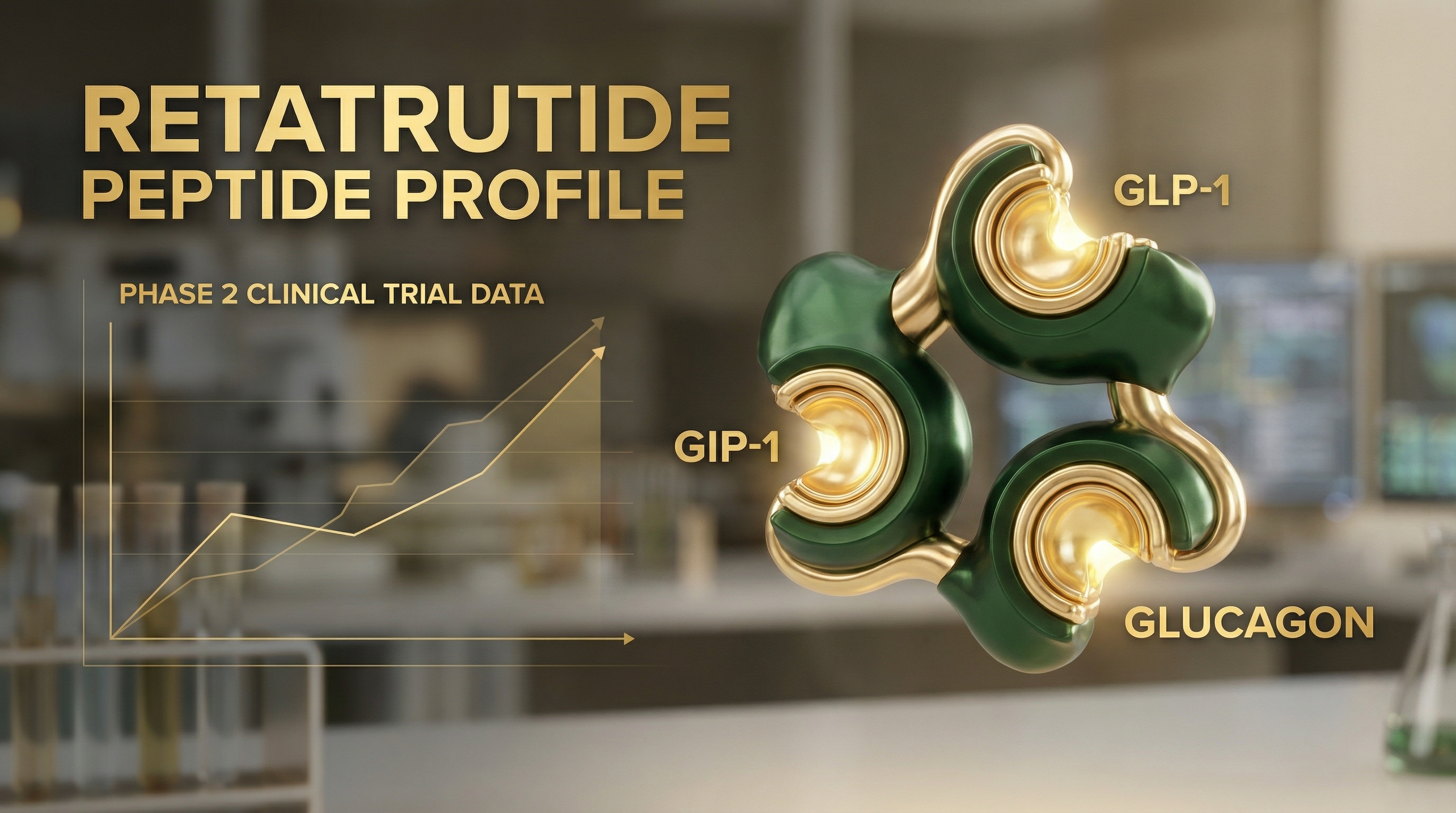
Retatrutide is Eli Lilly's experimental triple hormone receptor agonist — and the most powerful weight loss compound ever tested in a large-scale clinical trial. While Ozempic (semaglutide) targets one hormone receptor and Mounjaro (tirzepatide) targets two, retatrutide hits three at once: GLP-1, GIP, and glucagon. That third receptor — glucagon — is the game-changer. It does not just reduce how much you eat; it actively boosts your metabolism and increases the energy your body burns at rest. In the Phase 2 trial, participants lost up to 24% of their body weight over 48 weeks. In the TRIUMPH-4 Phase 3 obesity trial (results announced December 2025), participants on 12 mg weekly lost an average of 28.7% of their body weight — that is 71.2 pounds on an average starting weight of 248 lbs — over 68 weeks. 58% of participants on the highest dose achieved at least 25% weight loss. One in eight reported complete resolution of osteoarthritis knee pain. A separate Phase 3 trial in type 2 diabetes showed 16.8% weight loss (36.6 lbs) in just 40 weeks, with A1C reductions of 1.7–2.0%. Retatrutide is not yet FDA approved — an NDA submission is expected in Q4 2026 with approval projected for late 2027 — but it is already considered the next major leap in metabolic medicine.
Key Benefits
Mechanism of Action
Retatrutide works through three simultaneous hormone pathways, which is what makes it uniquely powerful. First, it activates GLP-1 receptors in the brain and gut — the same pathway as Ozempic — to suppress appetite, slow gastric emptying, and improve insulin secretion. Second, it activates GIP receptors — the same second pathway as Mounjaro — to enhance insulin sensitivity and fat metabolism. Third, and most importantly, it activates glucagon receptors in the liver and fat tissue. Glucagon is a hormone that normally raises blood sugar and increases energy expenditure. By activating glucagon receptors alongside GLP-1 (which counterbalances the blood sugar effect), retatrutide gets the metabolic boost of glucagon without the blood sugar spike. The result is a compound that reduces how much you eat AND increases how much energy your body burns — a combination no single or dual agonist can match.
Dosing Protocol
Typical Dose
4 mg once weekly (Phase 3 mid-dose)
Dose Range
1 mg (starting) to 12 mg (highest studied dose)
Frequency
Once weekly
Route
Subcutaneous injection (abdomen preferred; thighs or upper arms also acceptable)
Cycle Length
12–48 weeks (Phase 3 ran 40 weeks)
CLINICAL NOTES
Phase 3 trial used doses of 4 mg, 8 mg, and 12 mg weekly. Start at 1–2.5 mg once weekly for the first 4 weeks, then titrate up by 0.5 mg increments every 4–6 weeks as tolerated. Slow titration is critical to minimize GI side effects. Not yet FDA approved — currently research use only.
Reconstitution Guide
Vial Size
10 mg
BAC Water
1 mL (100 units)
Concentration
10 mg/mL
STEP-BY-STEP INSTRUCTIONS
Remove caps from the bacteriostatic water (BAC water) and Retatrutide vial. Clean both stoppers with alcohol swabs. Draw 100 units (1 mL) of BAC water and inject slowly into the Retatrutide vial. Gently swirl — do not shake. The solution is now 10 mg/mL.
DRAW VOLUME REFERENCE
| Dose | Units (U-100) | Volume (mL) |
|---|---|---|
| 1 mg | 10 units | 0.10 mL |
| 2 mg | 20 units | 0.20 mL |
| 2.5 mg | 25 units | 0.25 mL |
| 3 mg | 30 units | 0.30 mL |
| 5 mg | 50 units | 0.50 mL |
| 10 mg | 100 units | 1.00 mL |
STORAGE
Lyophilized powder: store in a cool, dry, dark area for up to 1 year. Once reconstituted: refrigerate and use within 45–60 days.
Side Effects & Safety
IMPORTANT DISCLAIMER
This information is for educational purposes only. Always consult a qualified healthcare provider before starting any peptide protocol. Individual responses vary and medical supervision is recommended.
Research References
TRIUMPH-4 Phase 3 Trial — Obesity (Eli Lilly Press Release, Dec 2025)
2025
Retatrutide Phase 3 Trial — Type 2 Diabetes (Eli Lilly, 2025)
2025
Retatrutide Phase 2 Trial — Obesity (NEJM 2023)
2023
Comparative Efficacy and Safety of Tirzepatide vs Retatrutide (PMC, 2025)
2025
Triple Agonist Mechanism Review (PubMed)
2023
Common Stacks
As a triple agonist (GLP-1/GIP/glucagon), retatrutide is typically run solo. Metabolic support peptides are the best complement.
Helps manage GI side effects during dose titration.
Tesamorelin's visceral fat targeting stacks well with retatrutide's broad metabolic action.
NAD+ supports mitochondrial function and energy metabolism alongside retatrutide's weight loss effects.
Frequently Asked Questions
Community Reviews
Real experiences from the Peptide Insights community
Have you used Retatrutide?
Real experiences from real people help others make informed decisions. Share what worked, what didn't, and what you wish you'd known before starting.
Free account required. Your review helps the Peptide Insights community.
No reviews yet for Retatrutide
Be the first to share your experience. Your insight could help someone else decide if Retatrutide is right for them.
Sign In to Be the FirstWant to go deeper on Retatrutide?
Get our free 32-page Beginner's Guide — plain-language breakdowns of the top peptides, dosing essentials, and safety basics.
Free Beginner's Guide
32-page PDF, instant download
Related Peptides
Compounds often researched alongside Retatrutide
Semaglutide
The breakthrough GLP-1 agonist for sustainable weight loss
Cagrilintide
Long-acting amylin analog with additive weight loss when combined with semaglutide
Tesamorelin
FDA-approved GHRH analog for visceral fat reduction
5-Amino-1MQ
NNMT inhibitor that promotes fat oxidation inside adipocytes without appetite suppression
Retatrutide vs. Tirzepatide (Mounjaro)
Both are from Eli Lilly. Both target GLP-1 and GIP. But one adds glucagon — and that changes everything.