Educational Use Only
Please read before exploring Peptide Insights
Important: The information on this website is intended for educational and research purposes only.
Peptide Insights provides information about peptides based on published scientific research and clinical literature. This content is designed to help you understand the science, not to guide personal medical decisions.
By continuing, you confirm that you are accessing this information for educational purposes and understand that it does not constitute medical advice.
Peptides for Glowing Skin: What Your Face Is Actually Telling You
Your skin is a biological scoreboard. Here's how peptides help you change the score.
Have you ever looked in the mirror and wondered why your skin just doesn't bounce back the way it used to? You're eating well, sleeping enough, and using a decent moisturizer. But something is off. The glow is gone. The lines are deeper. The texture feels different.
Here's something most skincare brands won't tell you: your face is a biological scoreboard. Every fine line, every patch of dullness, every spot of uneven tone is your skin showing you what's happening inside your body. And one of the biggest drivers of that change is a quiet shift in your body's internal communication network — specifically, the peptide signals that tell your cells what to do.
Let's explore what peptides actually are, why they matter for your skin, and which ones are worth your attention.
Your Body Has 37 Trillion Cells. They All Need Instructions.
Think about that for a second. Thirty-seven trillion cells, all coordinating together, every single day. How does your body manage that? Through signalling molecules — hormones, neurotransmitters, and peptides. They are the internal communication network that keeps everything running in harmony.
Peptides are short chains of amino acids, the same building blocks that make up proteins. Their job is to deliver precise instructions to specific cells. Some tell your skin to produce more collagen. Others instruct your muscles to repair. Some nudge your pituitary gland to release more growth hormone.
As we age, that signalling network starts to drift. The messages get quieter, less frequent, and less precise — particularly from our late twenties onward. When the signals that govern repair, regeneration, and metabolism begin to fade, the downstream effects are exactly what we associate with ageing: slower healing, less resilient skin, declining energy, and shifting body composition.
That signal drift is biological ageing. Or at least a major driver of it.
Why Results Vary — and What Most People Miss
Here's something that most conversations about peptides skip over entirely. Peptides work by sending a specific instruction — repair this tissue, produce more collagen, release more growth hormone. But if the environment they're signalling into is hostile (due to chronic inflammation, poor sleep, or environmental toxicity), the message doesn't land properly.
Think of it like trying to have a conversation in a noisy restaurant. The signal is there, but the background noise drowns it out.
When the terrain is favourable, some effects are surprisingly fast. People using growth hormone-releasing peptides often notice better sleep and faster recovery within the first seven to ten days. That's because you're restoring a signalling pathway that was already there but had simply dulled over time.
Skin-specific results tend to build more gradually. Collagen synthesis is a remodelling process, not an overnight fix. Most people begin to see visible improvements in texture, firmness, and glow at around the four-to-six-week mark, with compounding benefits over three to six months.
The Four Peptides Worth Knowing for Your Skin
Not all peptides are created equal when it comes to skin. Here are the four that consistently show up in both the research and in clinical practice.
1. GHK-Cu (Copper Peptide) — The Gold Standard
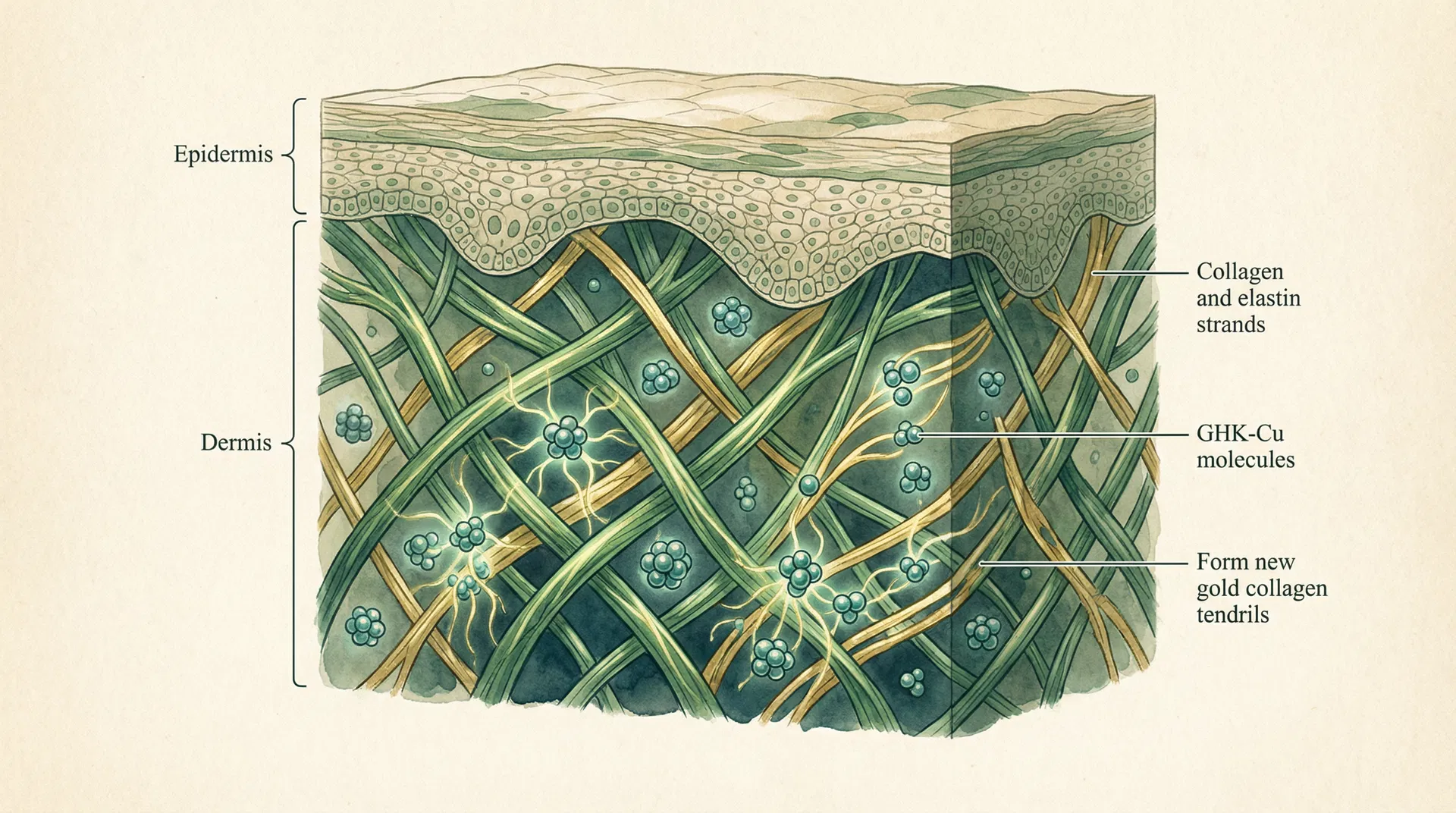
GHK-Cu is the most well-researched skin peptide in existence. It stimulates collagen and elastin production, has powerful anti-inflammatory effects both topically and systemically, and essentially resets your skin's repair and rejuvenation cycle to a younger pattern.
What makes GHK-Cu remarkable is its versatility. You can use it as a topical serum for a gentle, daily approach, or for a more intensive effect, it can be administered as a subcutaneous injection. Either way, it activates over 4,000 genes involved in tissue repair and regeneration — a number that still surprises researchers who study it.
For pigmentation and uneven tone specifically, GHK-Cu plays a strong role. Its antioxidant and anti-inflammatory properties help calm the cascade that triggers excess melanin production. If you're dealing with post-inflammatory hyperpigmentation or sun damage, this is your starting point.
2. BPC-157 — The Circulation Booster
BPC-157 is a brilliant complement to GHK-Cu. While GHK-Cu is rebuilding the structural scaffold of the skin, BPC-157 promotes the formation of new blood vessels — a process called angiogenesis. That's what gives skin that natural flush of vitality and that "alive" quality.
Better blood supply means more oxygen and nutrients reaching the skin cells doing the repair work, and waste products being efficiently removed. Together, GHK-Cu and BPC-157 form a powerful pairing: one rebuilding, the other feeding the rebuild.
| Peptide | Primary Mechanism | Best For | Delivery |
|---|---|---|---|
| GHK-Cu | Collagen + elastin synthesis, anti-inflammatory | Firmness, texture, pigmentation | Topical or injectable |
| BPC-157 | Angiogenesis (new blood vessel formation) | Glow, vitality, wound healing | Injectable or oral |
| Acetyl Hexapeptide-8 | Muscle contraction inhibition | Expression lines, forehead, crow's feet | Topical only |
| NAD+ | Cellular energy (mitochondrial support) | Overall skin renewal, fibroblast function | IV, oral, or injectable |
3. Acetyl Hexapeptide-8 — "Botox in a Bottle"
Acetyl Hexapeptide-8 is often called "Botox in a bottle" because it softens expression lines by calming the repetitive muscle contractions that cause them. It's a topical-only option, which makes it the most accessible entry point for anyone new to peptides.
For anyone already using Botox, it's actually an excellent complement rather than a replacement. It's particularly effective on the finer lines in more delicate areas that Botox doesn't always reach — around the eyes, the upper lip, and the forehead. There's also emerging evidence that using it between sessions may help extend the duration of a Botox treatment.
For those who'd rather avoid needles altogether, it offers a gentler route to a smoother, more rested appearance.
4. NAD+ — The Electricity Behind the Factory
NAD+ is not technically a peptide, but it belongs in this conversation. It's a coenzyme that every cell in your body depends on for energy production and DNA repair. For skin specifically, it powers the mitochondria inside your fibroblasts — the cells responsible for producing collagen and elastin.
As NAD+ levels decline with age (and they decline significantly after 40), those fibroblasts lose the energy they need to do their job properly. Restoring NAD+ essentially re-energises the cellular engine behind skin renewal and repair. If peptides are the instructions, NAD+ is the electricity that keeps the factory running.
What Your Face Is Actually Telling You
Pigmentation, fine lines, and dullness aren't just "skin problems." They're skin-based manifestations of biological ageing happening systemically across your entire body. Your face is showing you, in real time, how the major drivers of ageing — chronic inflammation, metabolic dysfunction, oxidative stress — are progressing beneath the surface.
That's actually good news. Because it means that any intervention that positively influences those systemic drivers will also produce visible skin benefits. Peptides that reduce inflammation, stimulate repair, and restore cellular energy don't just improve your skin. They improve the underlying biology that your skin is reflecting.
So the question isn't really "which serum should I buy?" The question is: what signals does your body need more of right now?
Where to Start
If you're new to peptides and want to start with skin as your focus, here's a practical approach:
Topical first: Start with a GHK-Cu serum applied morning and evening. Look for products with copper peptide listed in the first five ingredients. Add an Acetyl Hexapeptide-8 eye cream if expression lines are your primary concern. Give it six weeks before evaluating results.
Injectable for deeper results: If you want more significant collagen remodelling or are dealing with chronic inflammation, GHK-Cu and BPC-157 as subcutaneous injections offer a more direct signal. This is best done with guidance from a functional medicine practitioner who understands peptide protocols.
Support the terrain: Remember the noisy restaurant analogy. Peptides work better when the environment is favourable. Prioritise sleep, reduce processed food, manage chronic stress, and consider NAD+ support if you're over 40. The peptides will do more when the background noise is lower.
The Bottom Line
Peptides are not a magic fix. They're a communication tool. They work by restoring the precise cellular instructions that your body already knows how to use — instructions that have simply gotten quieter with age.
When you give your cells the right signals in the right environment, the results compound over time. Better skin is one of the most visible signs of that. But it's just the surface of what's actually changing underneath.
Ready to explore the specific peptides mentioned in this article? Check out our full profiles on GHK-Cu and BPC-157, or if you want the combined approach, the GLOW Peptide Blend combines both into a single protocol designed for skin and anti-aging.
References
- Pickart L, Margolina A. "Regenerative and Protective Actions of the GHK-Cu Peptide in the Light of the New Gene Data." International Journal of Molecular Sciences, 2018. PubMed
- Sikiric P, et al. "Stable Gastric Pentadecapeptide BPC 157: Novel Therapy in Gastrointestinal Tract." Current Pharmaceutical Design, 2018. PubMed
- Pickart L. "The Human Tri-Peptide GHK and Tissue Remodeling." Journal of Biomaterials Science, 2008. PubMed
- Massudi H, et al. "Age-Associated Changes in Oxidative Stress and NAD+ Metabolism in Human Tissue." PLOS ONE, 2012. PubMed
- Lim EY, Kim YT. "Acetyl Hexapeptide-3 and Its Effects on Skin Aging." Cosmetics, 2020. MDPI
Peptide Insights Editorial Team
Research & Editorial
David Steel is an entrepreneur, mentor, and health optimization advocate. He founded Peptide Insights to bring research-backed, plain-language education to the growing world of peptide science. He is passionate about longevity, clean energy, and empowering people to make informed health decisions.
Comments
Sign in to join the conversation
Sign In / RegisterNo comments yet. Be the first to share your thoughts!