Educational Use Only
Please read before exploring Peptide Insights
Important: The information on this website is intended for educational and research purposes only.
Peptide Insights provides information about peptides based on published scientific research and clinical literature. This content is designed to help you understand the science, not to guide personal medical decisions.
By continuing, you confirm that you are accessing this information for educational purposes and understand that it does not constitute medical advice.
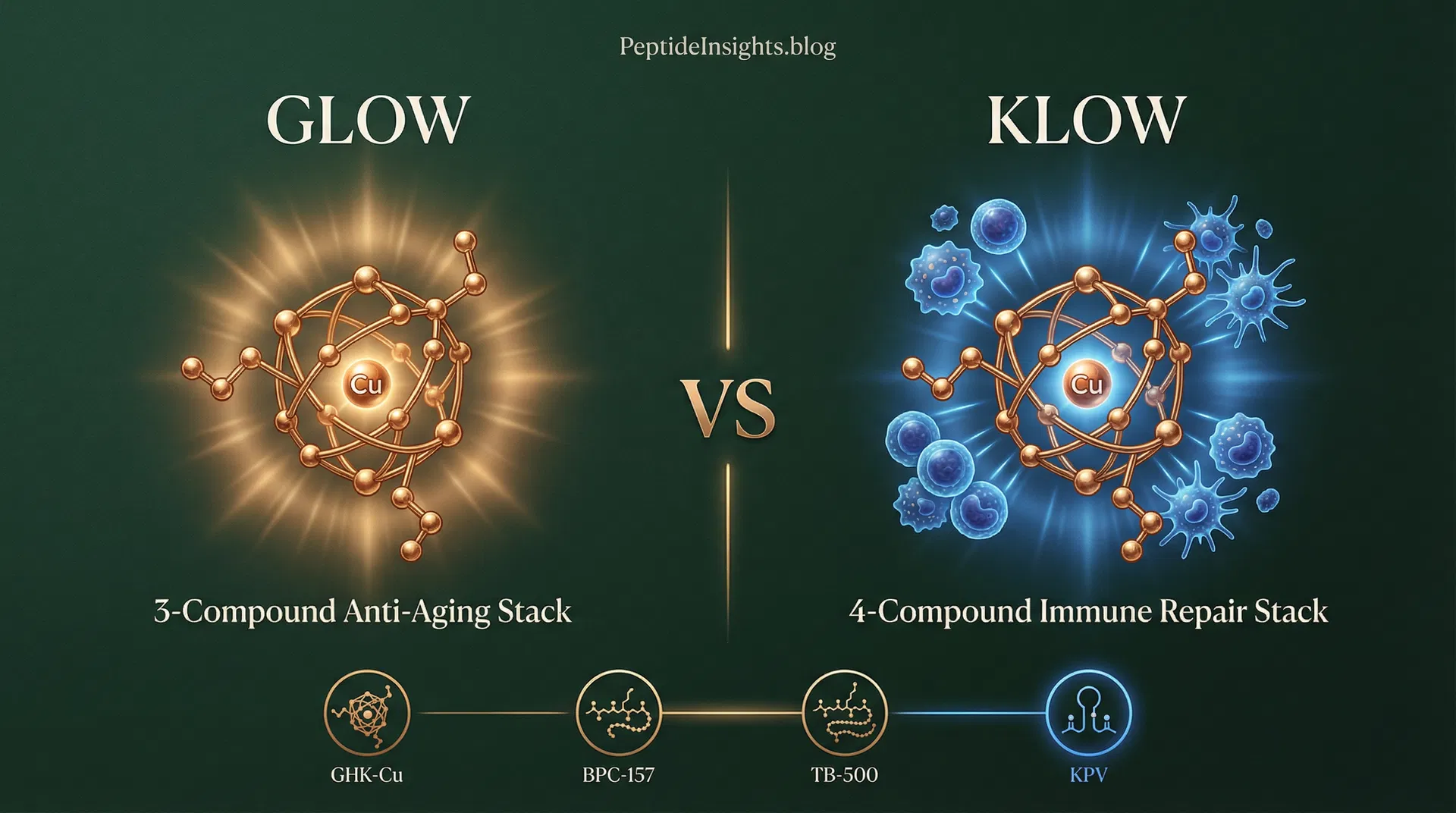
GLOW vs. KLOW
Both are 4-in-1 high-potency healing blends sharing the same three-compound base. The difference is one compound that changes everything. Here is the full breakdown.
What Each Compound Does
Both blends share the same three-compound healing foundation. KLOW adds KPV as a fourth compound, which is the only difference between them. That one addition opens up an entirely different set of applications.
| Feature | GLOW | KLOW |
|---|---|---|
| GHK-Cu (Copper Peptide) | ||
| BPC-157 (Body Protection Compound) | ||
| TB-500 (Thymosin Beta-4) | ||
| KPV (Lys-Pro-Val) | ||
| Skin & Anti-Aging Focus | ||
| Deep Immune Modulation | ||
| GI / IBD Application | ||
| Musculoskeletal Repair | ||
| Protocol Simplicity |
The Regeneration Trio
The Immune Repair Stack
Head-to-Head: Use Case Comparison
Since both blends share the same base, the comparison comes down to where each one excels and which use cases are unique to KLOW.
| Category | GLOW | KLOW |
|---|---|---|
| Primary Use Case | TieAnti-aging, skin vitality, tissue repair | TieChronic inflammation, immune modulation, GI repair |
| Compound Count | Tie3 (GHK-Cu, BPC-157, TB-500) | Tie4 (GHK-Cu, BPC-157, TB-500, KPV) |
| Skin & Hair Results | WinnerStrong — GHK-Cu is the primary driver | Strong — same GHK-Cu base, KPV adds anti-inflammatory skin support |
| Inflammation Control | Moderate — BPC-157 provides local anti-inflammatory action | WinnerDeep — KPV adds systemic melanocortin-mediated immune suppression |
| GI / Gut Health | Mild — BPC-157 has some GI protective effects | WinnerStrong — KPV specifically targets gut mucosal repair |
| Musculoskeletal Repair | TieStrong — TB-500 + BPC-157 is a proven healing combination | TieStrong — same base, KPV adds reduced inflammatory burden |
| Protocol Complexity | WinnerSimpler — 3 compounds to manage | Slightly more complex — 4 compounds, oral KPV option for GI |
| Research Depth | TieStrong — all 3 compounds have extensive published data | TieStrong — KPV adds well-studied melanocortin pathway evidence |
Which Blend Is Right for You?
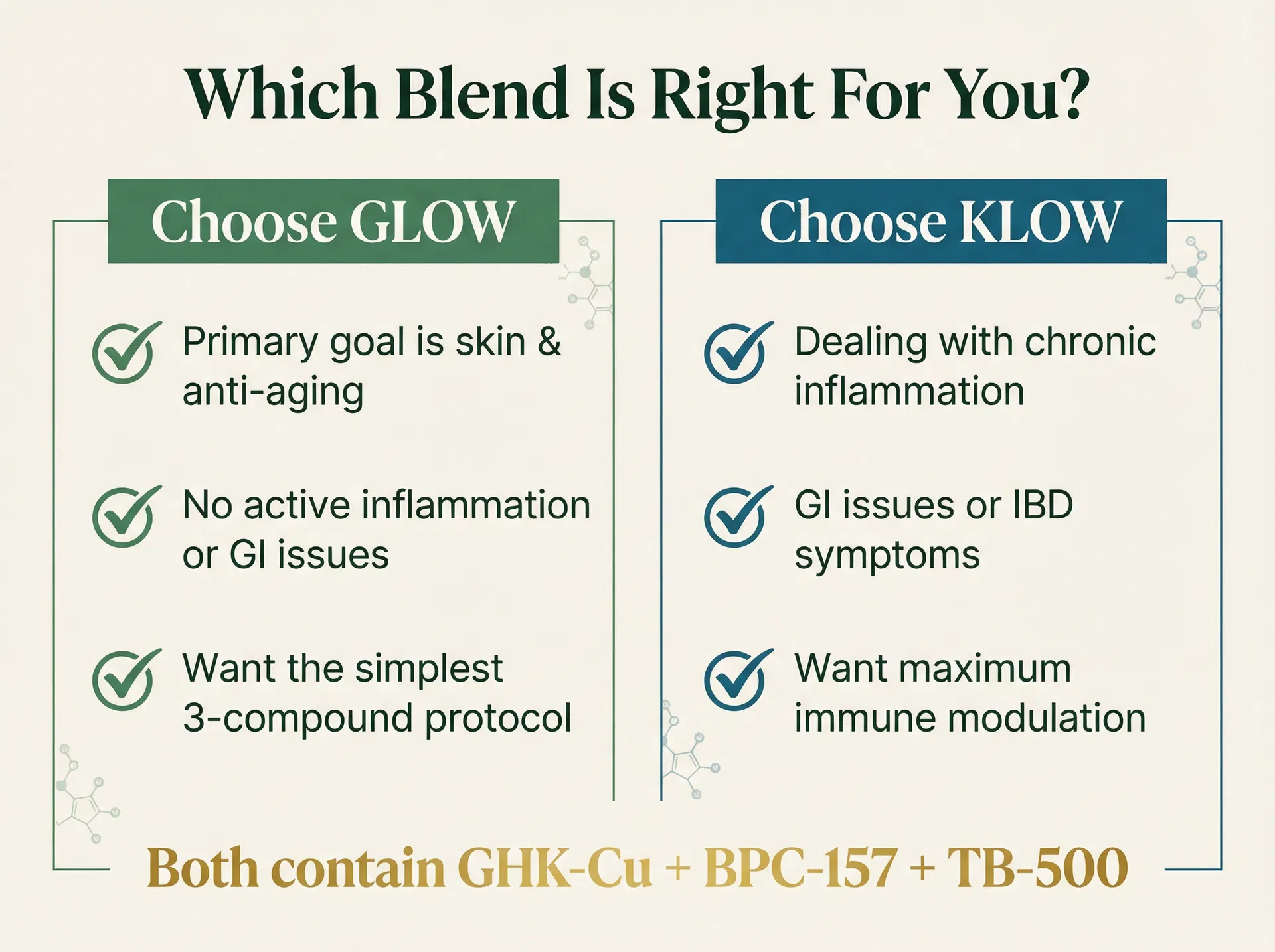
Choose GLOW if you...
- Your primary goal is skin quality, collagen, and anti-aging
- You do not have chronic inflammation or GI issues
- You want the simplest 3-compound protocol to start with
- You are focused on musculoskeletal recovery without immune complexity
Choose KLOW if you...
- You are dealing with chronic inflammation or an autoimmune condition
- You have GI issues, IBD, Crohn's, or gut mucosal damage
- You want maximum immune modulation alongside tissue repair
- You want the option to use KPV orally for gut-specific targeting
Dosing Protocols
Both blends follow the same injection protocol. The only practical difference is that KLOW's KPV component can optionally be taken orally for gut-specific applications.
| Protocol Aspect | GLOW | KLOW |
|---|---|---|
| Typical Dose | 250–500 mcg/day | 250–500 mcg/day |
| Injection Frequency | Once daily (subcutaneous) | Once daily (subcutaneous) |
| Cycle Length | 4–8 weeks on, 2–4 weeks off | 4–8 weeks on, 2–4 weeks off |
| Oral Option | Not applicable | KPV can be taken orally for GI-specific use |
| Storage | Refrigerated, protect from light | Refrigerated, protect from light |
| Reconstitution | BAC water, standard protocol | BAC water, standard protocol |
| Best Time to Inject | Morning or post-workout | Morning or post-workout |
Side Effects & Safety
Both blends have well-tolerated safety profiles. The main additional consideration with KLOW is KPV's immune-modulating activity, which requires caution if you are on immunosuppressant medication.
| Side Effect | GLOW | KLOW |
|---|---|---|
| Injection Site Redness | Mild, temporary | Mild, temporary |
| Fatigue (initial) | Occasional | Occasional |
| Nausea | Rare | Rare |
| Skin Flushing | Rare | Possible with KPV (melanocortin effect) |
| Immunosuppression Risk | Very low | Low — caution with active infections |
| Interaction with Immunosuppressants | None known | Consult provider — KPV modulates immune pathways |
| GI Discomfort | Rare | Rare (KPV typically improves GI symptoms) |
Frequently Asked Questions
References
- 1. Pickart L, Margolina A. "Regenerative and Protective Actions of the GHK-Cu Peptide in the Light of the New Gene Data." Int J Mol Sci, 2018. PubMed
- 2. Sikiric P, et al. "Stable Gastric Pentadecapeptide BPC 157: Novel Therapy in Gastrointestinal Tract." Curr Pharm Des, 2018. PubMed
- 3. Goldstein AL, et al. "Thymosin β4: A Multi-Functional Regenerative Peptide." Expert Opin Biol Ther, 2012. PubMed
- 4. Dalmasso G, et al. "The Tripeptide KPV Has Anti-Inflammatory Effects in the Intestinal Epithelial Cell Line HT-29." Peptides, 2008. PubMed
- 5. Brzoska T, et al. "Alpha-Melanocyte-Stimulating Hormone and Related Tripeptides: Biochemistry, Anti-Inflammatory and Protective Effects." Endocr Rev, 2008. PubMed
Explore Each Blend in Detail
Read the full peptide profiles for GLOW and KLOW, including complete dosing protocols, reconstitution guides, and FAQ sections.